
Your crown has come off, and the tooth underneath looks dark, maybe even black. You look in the mirror and wonder whether the tooth is dead. If that is where your head is right now, you are in good company. It is one of the most common things patients tell us when they ring up in a panic.
First, breathe. A crown that fell off with a black tooth underneath sounds grim, but most of these teeth can be saved. The catch is that you cannot leave it. Below I will explain why crowns come off, what the black colour actually means, what to do (and not do) at home, and what happens in the dentist's chair, the way I would explain it if you were sitting across from me.
Crown fell off? Here is what to do first
Before the detail, here is the short list that will help you right now.
- Find the crown and keep it. Put it in a clean container or a small bag, and be careful not to swallow it. Sometimes an old crown can be cleaned and reused. Other times, looking inside it tells us a lot about the state of the tooth.
- Rinse with warm salt water. It cleans around the exposed tooth and calms the gum.
- Do not chew on that side. A tooth without its crown is thin and fragile. A hard nut can finish it off.
- Book a dentist today or tomorrow. Tell the receptionist "my crown fell off and the tooth is black" so we can give you the right slot.
- Swelling, fever or severe pain? Do not wait. Come in the same day.
Why do crowns fall off?
A crown is a sleeve that sits over your tooth. Two things keep it in place: a solid tooth underneath and a strong layer of dental cement in between. If either one fails, the crown comes off. You might call it a cap, a porcelain crown or a zirconia crown, but the logic is the same.
- The cement has worn out. Years of hot tea, cold water and chewing pressure take their toll. Cement does not last forever, and this is the most harmless reason.
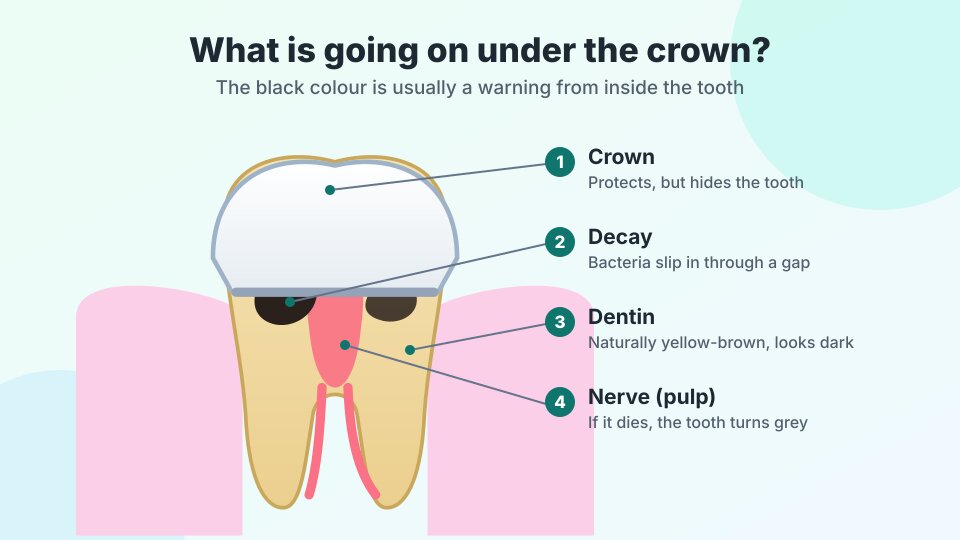
- There is decay underneath. If a hairline gap opens at the edge of the crown, bacteria creep in and eat the tooth from the inside. Eventually the crown has nothing solid left to hold on to. This is the usual story behind a black tooth.
- The tooth has cracked or broken. A crown cannot grip a cracked foundation.
- You clench or grind. Night-time pressure you are not aware of slowly loosens a crown. Waking up with a sore jaw is a clue.
- Hard or sticky food. Ice, nuts, hard sweets, toffee and chewing gum are a crown's worst enemies. So is using your teeth as tools to open packets.
- The tooth stump was short to begin with. The less tooth there is to hold on to, the weaker the grip.
Why is the tooth under my crown black?
Most people jump straight to "it's dead." That is not unreasonable, but a black tooth does not always tell the same story.
Decay
This is the one we see most. Bacteria get under the crown, and the tooth turns brown, then black. When we press on it in the chair, the tissue feels soft. There may be a bad taste or smell. If the decay is deep, it hurts, but it does not always.
A dead nerve
Inside every tooth is a living core of nerves and blood vessels called the pulp. If decay or a knock inflames it and it dies, breakdown products seep into the hard layer around it (the dentin) and the tooth turns grey or dark. Here is the annoying part: a dead nerve does not always hurt. It can stay quiet for years and then show up as an abscess. So "no pain" does not mean "no problem."
An old filling or metal core
If there is an old amalgam filling or a metal post and core under the crown, it can give the tooth a grey-black tint over time. That is not always an infection, but it still needs a look.
The natural colour of dentin
When the crown comes off, you are no longer looking at white enamel. You are looking at dentin, which is naturally yellow-brown. Tea, coffee, smoking and plaque stain it quickly and it looks far darker than you expect. Sometimes the tooth is simply stained.
| What you see | What it usually means | How urgent |
|---|---|---|
| Dark brown to black, pitted or soft | Decay | Within a few days |
| Grey and dull, on a single tooth | The nerve may be dead | Within a few days; same day if there is pain or swelling |
| Grey-black and hard, like an old filling | Old metal filling or core | Checked at the exam |
| Yellow-brown, hard and smooth | Normal dentin or surface staining | Still should not stay exposed |
You cannot tell these apart in the mirror. Whether it is decay, a dead nerve or just staining, only an exam and an X-ray will show.
My crown fell off but nothing hurts. Can I wait?
This is the question I hear most, and the answer is clear: no, you should not wait. The moment the crown is gone, the tooth is unprotected, and that has three consequences.
- Decay speeds up. Bacteria that were creeping along quietly now get fresh food at every meal.
- Teeth move. Within weeks the neighbouring tooth can drift into the gap and the tooth above or below can grow out to meet it. Then the old crown no longer fits and a new one has to be made.
- A small job becomes a big one. Today it could be a half-hour re-cementing. A few months from now it could be a root canal and a new crown, or even an extraction.
Signs you should not wait for your appointment
If you have any of these, see a dentist the same day:
- Throbbing pain, especially pain that wakes you at night
- Sharp pain when you bite
- Swelling of the gum, or a pimple-like bump on it
- A bad taste or smell that will not go away
- Fever
If swelling is spreading across your face or neck, or you have trouble swallowing or breathing, skip the dentist and go straight to the emergency room.
What can I do at home until my appointment?
These are not treatments. They just keep the tooth calm.
What you can do
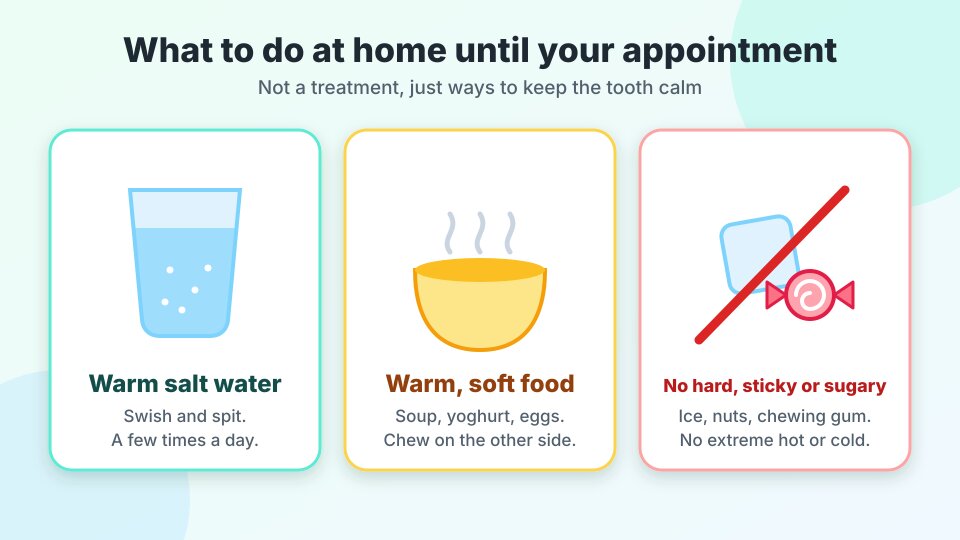
- Warm salt water: Half a teaspoon of salt in a glass of warm water. Swish after meals.
- Soft, warm food: Soup, yoghurt, eggs, mash. Chew on the other side.
- A soft toothbrush: Go gently around the exposed tooth. Do not scrub it.
- A painkiller if you need one: Use your usual over-the-counter painkiller at the dose on the leaflet. If you take blood thinners or have a medical condition, check with a pharmacist first.
What you should not do
- Do not put aspirin on the tooth or gum. It burns the tissue and leaves a sore.
- Avoid very hot, very cold or icy drinks.
- Stay away from hard, sticky and sugary food.
- Do not poke the exposed tooth with your tongue, a fingernail or a toothpick.
Can I glue the crown back on myself?
Short answer: no. Superglue or any household glue is out of the question. It can harm the tooth and gum, it traps any decay underneath, and it makes it harder for us to remove the crown later. The cements dentists use are strong, but they are also designed to come off safely when needed.
Pharmacies sell temporary dental cement kits. If you genuinely cannot see a dentist for a few days, the crown is clean, the tooth does not hurt and the crown seats fully, a kit can be a stop-gap. If the tooth underneath is black or soft, or the crown does not sit properly, do not try it, and do not force anything.
And if the crown is loose but still on the tooth, do not pull it off yourself. You can break the tooth or expose the nerve.
What does the dentist do?
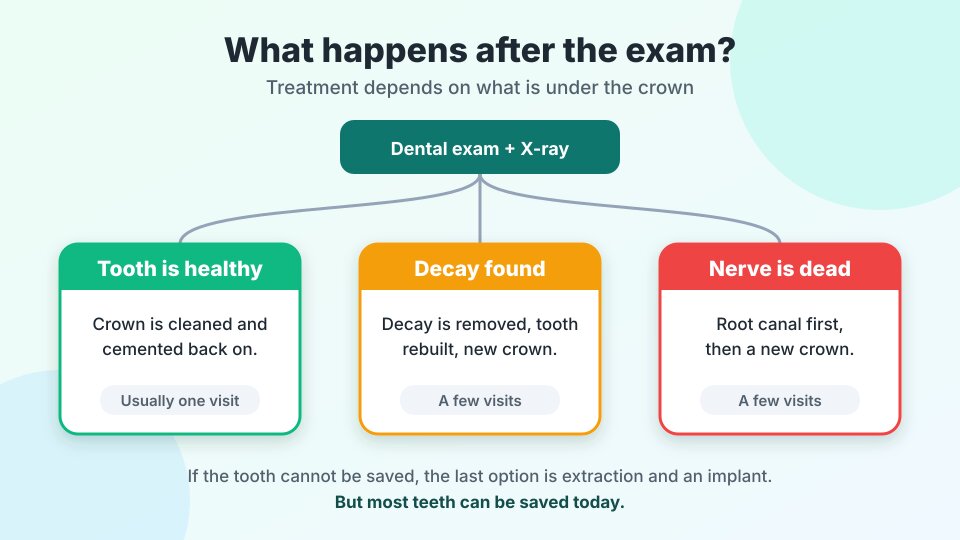
The point of the exam is to see what is under the crown. We look in your mouth, take an X-ray and test the tooth with cold and tapping. We also look inside the crown that came off, because if there is decay stuck in it, that tells half the story. After that, it goes one of three ways.
The tooth is healthy: the crown is cemented back
The tooth and the inside of the crown are cleaned and the crown goes back on with fresh cement. This is usually one short visit. It is the outcome everyone hopes for.
There is decay: the tooth is rebuilt and the crown renewed
All the decay is removed and the tooth is built back up with a filling. Because the shape of the tooth changes, the old crown often no longer fits. We take a new impression and make a new crown (porcelain or zirconia) while a temporary one protects the tooth. How long the new crown takes depends on the clinic. Some can do it the same day, others need a few days.
The nerve is dead: a root canal comes first
The name sounds scary, but it is a treatment that saves the tooth. Under local anaesthetic the dead tissue is cleaned out and the canals are disinfected and sealed. You should not feel pain during it. A tooth without a nerve is more brittle, so it is strengthened with a new crown afterwards, and the crown also hides any dark colour. You do not always need the whole crown removed for this; we can often reach the tooth through it. If the crown is not suitable, it is replaced.
The tooth cannot be saved
If the tooth is badly broken down, the root has cracked or decay has reached the bone, extraction becomes an option. It is the last resort, and the gap can then be restored with an implant or a bridge. We always look for a way to save the tooth first, and a good share of black teeth can be saved today.
As for cost, a figure only makes sense after an exam and X-ray. What I can say is that the cheapest route is coming early. The gap between re-cementing and a root canal plus new crown is the price of waiting.
How to stop it happening again
- Come for a check-up every six months. Catching a problem at the edge of a crown before it hurts is far easier.
- Clean the line where the crown meets the gum. Floss or an interdental brush does the job here, and it is where decay usually starts.
- If you grind your teeth, get a night guard. It protects the crown and your natural teeth.
- Give ice, nut shells and hard sweets a miss.
- Do not use your teeth as tools. Packets, thread and bottle tops are not their job.
With good care, a crown often lasts 10 to 15 years or more. What matters most is not the material but the health of the tooth underneath.
Frequently asked questions
Is a crown that fell off an emergency?
Usually not a "rush to the hospital tonight" situation, but it should not be put off. If you have pain, swelling or fever, see a dentist the same day. If not, aim for within two or three days.
Does a black tooth under a crown mean it is dead?
Not always. The darkness can come from decay, an old metal filling or simple staining of the dentin. It can also mean the nerve has died. An exam and X-ray tell us which.
Can a crown that fell off be put back on?
Yes, if the tooth is free of decay and the crown is intact, usually in a single visit. If there is decay underneath, the tooth changes shape and you will most likely need a new crown.
Can a black tooth be saved?
Often, yes. We remove the decay, do a root canal if needed, and finish with a new crown. Extraction is the last option.
My crown fell off and there is no pain. Can I wait a month?
I would not. No pain does not mean the tooth is healthy. In that time decay can advance, a neighbouring tooth can move, and the old crown may stop fitting.
Can you do a root canal on a tooth that has a crown?
Yes. We can reach the tooth through the crown and seal the access hole afterwards. If the crown is unsuitable or damaged, it is replaced.
Do not put off the appointment
If your crown fell off and the tooth underneath is black, there is no need to panic, but there is a need to act. In most cases there is a fix, and how big that fix turns out to be depends on how long you wait.
This article is for general information and does not replace an examination.