
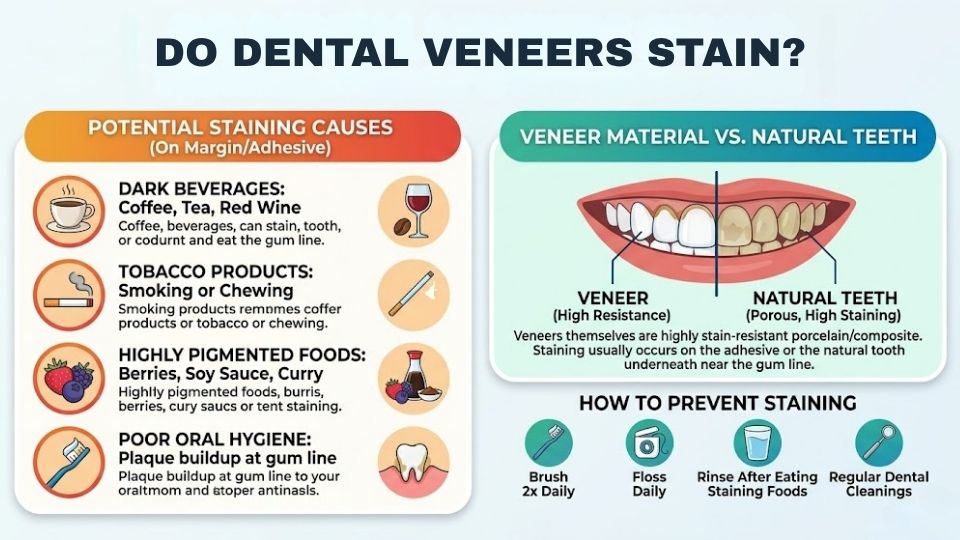
Porcelain dental veneers are highly resistant to staining as they are made from high-tech materials, and unlike natural tooth enamel, they are not easily affected by substances such as coffee, tea, or cigarette smoke. However, there are several critical points to be aware of regarding the staining of veneers.
What causes porcelain veneers to appear stained?
Although porcelain dental veneers are much more resistant to staining than natural tooth enamel, there are several key factors that can cause them to appear 'stained' or 'discolored' over time. The reasons for this are as follows:
External (Surface) stains
Porcelain veneers have a smooth, glass-like surface; however, this does not mean that nothing can accumulate on them.
Food and drink:
Coffee, tea, red wine, dark-colored acidic drinks (such as cola), soy sauce, and foods with intense pigments, such as blackberries, can cause small surface stains on the porcelain over time.
Tobacco use:
Cigarettes and other tobacco products are one of the most common external factors causing discoloration on veneers.
Marginal discolouration
This is a problem that occurs at the margins where the veneer meets the natural tooth, rather than on the veneer itself.
Substances that accumulate over time at the point where the veneer is bonded to the tooth, or a slight discoloration of the bonding agent (cement), can cause the margins to appear darker.
Gum recession and changes in the natural tooth
Sometimes a veneer may appear stained, but the problem actually lies in the surrounding tissues.
Exposure of the Root Surface:
If the gums recede over time, the natural tooth root where the veneer ends may become exposed. As this root surface is usually darker or yellower than the veneer, a stained appearance develops at the base of the tooth.
Loss of color match:
As your natural teeth age or become discolored due to external factors, the color match with your porcelain veneers—which retain their color—is lost, and this can cause the veneers to appear 'different' or 'stained.'
Reflection of the underlying tooth's colour
Porcelain veneers possess a certain degree of translucency.
Thin veneers:
If the veneer is very thin (for example, 0.5 mm), the dark color of the underlying natural tooth or stains caused by medications such as tetracycline may be visible from the outside. This creates the illusion that the veneer is stained.
Adhesive (Cement) color:
The color of the adhesive used to bond the veneer to the tooth can also affect the overall aesthetic appearance.
Loss of Gloss (Wear)
The 'gloss and shine' of the porcelain is its most important protective feature.
Using very hard toothbrushes or abrasive (grained) toothpastes can, over time, cause microscopic scratches on the porcelain's smooth surface. Surfaces with a damaged gloss begin to retain stains more easily.
Comparison of porcelain and composite veneers (Staining)
Porcelain veneers offer the highest level of protection against staining thanks to their glass-like, non-porous structure, whereas composite veneers, although a more economical option, are more prone to discoloration over time. In both types, the most common colour-related issue is discolouration occurring at the margins where the veneer meets the tooth, rather than on the veneer itself
|
Feature |
Porcelain Veneers |
Composite Veneers |
|
Stain Resistance |
Highly resistant to stains from coffee, tea, and cigarette smoke. |
Stain more easily compared to porcelain materials. |
|
Material Property |
Manufactured using high-tech, non-porous ceramic materials. |
Made of resin-based materials that are more prone to picking up pigments. |
|
Maintenance |
Minor surface stains can be easily polished back to their original lustre by a dentist. |
Can be easily polished, repaired, or replaced if discoloration occurs. |
|
Common Issues |
Marginal discoloration (at the edges) is the most frequent complication (39.2%). |
Frequent exposure to pigmented foods and lack of compliance can lead to faster staining. |
|
Longevity of Color |
Should "never stain" under normal conditions and hygiene. |
Requires more frequent monitoring and potential replacement due to staining |
What steps should be taken to prevent staining on dental veneers?
To prevent staining on dental veneers (particularly porcelain ones) and to maintain their aesthetic appearance for the long term, a comprehensive approach involving both daily care and professional support is required. The steps to follow are as follows:
Daily oral hygiene practices
Although the care of veneers does not require a special procedure, they should be cleaned with the same care as natural teeth.
- Regular brushing: Teeth should be brushed twice a day for two minutes each time, using the correct technique.
- Dental floss and mouthwashes: In addition to brushing, dental floss should be used daily and the mouth should be rinsed with antiseptic mouthwashes after meals.
- Maintaining gum health: Good oral hygiene not only cleans the crowns but also reduces the risk of gum recession (gingival recession). Gum recession can lead to aesthetic issues by exposing the margins of the crowns or the tooth root.
Choosing the right products
The quality of the products used to maintain the surface polish of veneers is very important.
- Soft toothbrush: A soft toothbrush must be used to avoid damaging the shine and polish of porcelain veneers.
- Non-abrasive toothpaste: Dentists generally recommend non-abrasive fluoride toothpaste. Toothpastes with coarse granules can create microscopic scratches on the veneer surface, making it easier for stains to adhere.
Dietary and lifestyle changes
Although porcelain veneers are much more resistant to staining than natural tooth enamel, external discoloration can build up over time.
- Avoiding staining foods: Consumption of foods with a high potential to cause staining, such as coffee, tea, red wine, soy sauce, dark-colored acidic drinks, and blackberries, should be minimized.
- Quitting smoking: Tobacco use is one of the most common causes of discoloration of teeth and veneers; therefore, patients with veneers are advised to quit smoking.
Professional care and check-ups
Regular visits to the dentist are essential to prolong the life of your veneers.
- Six-monthly check-ups: A regular dental check-up and professional cleaning every six months are recommended.
- Professional polishing: If minor surface stains develop on the veneers, these can be polished back to their original shine by the dentist using a specially formulated, non-abrasive paste.
Preventative measures
Preserving the physical integrity of the veneers also helps prevent the formation of cracks that could indirectly trap stains.
- Night guard: Custom-made night guards are recommended for patients with a habit of teeth grinding or clenching (bruxism). These devices reduce stress on the veneers, preventing damage.
- Avoiding hard objects: Habits such as biting pencils, chewing ice, or biting nails can damage the veneers, so these behaviors should be avoided.
How long do veneers last?
Although the lifespan of veneers varies depending on the material used and the patient's oral hygiene, clinical experience suggests it is generally between 7 and 20 years.
- General expectation: For most patients, the useful lifespan of veneers is expected to be at least 10 to 15 years.
- Special materials: Some 'no-prep' (applied without grinding the tooth) veneers currently available on the market can last up to 15 to 20 years.
- Success rates: Clinical studies show that porcelain laminate veneer restorations have a survival rate of over 90% after 10 years of use
The top 3 tips to keep your veneers stain-free throughout their lifespan:
Firstly, drink dark-colored beverages through a straw and rinse with water immediately afterwards.
Secondly, avoid abrasive toothpastes and vigorous brushing—use a soft-bristled brush and a gentle toothpaste.
Thirdly, have your teeth professionally cleaned and polished by a dentist every six months. If you follow these three steps, your porcelain veneers will remain stain-free for over 10 years, and your composites for 3–4 years.
F.A.Q:
Do dental veneers really never stain at all?
Unfortunately, that's not entirely true. Porcelain veneers are quite stain-resistant, but they are not completely immune. Composite veneers, on the other hand, stain more easily. So, the idea that they 'never stain' is a myth, but they are much more resistant than natural teeth.
Will drinking coffee discolor my veneers?
Yes, over time, dark drinks such as coffee, tea, and red wine can cause discoloration, particularly in composite veneers. This effect is much less pronounced in porcelain, but it can still be noticeable with excessive consumption. Rinsing your mouth with water immediately afterwards is a good habit.
How harmful is smoking in terms of staining veneers?
It is quite harmful. Nicotine and tar form a yellow-brown layer, particularly on composite veneers. Porcelain veneers also become dull over time due to cigarette smoke. Furthermore, as it damages your gums, unsightly discoloration may form around the edges of the veneers.
What is the difference in stain resistance between porcelain and composite veneers?
Porcelain has a surface as smooth as glass, so it is by far the superior option in terms of stain resistance. Composite, on the other hand, is a more porous material, so it is easily affected by substances such as coffee, tea, ketchup, and soy sauce. Porcelain may become slightly dull over the years, but composite can change color noticeably within 1–2 years.
Do whitening toothpastes damage veneers?
Yes, be careful. Whitening toothpastes usually contain abrasive particles. These particles scratch the glossy surface of porcelain and make composite appear dull, causing it to stain more quickly. Gentle toothpastes containing fluoride and designed for sensitive teeth are safer.
My veneer has yellowed; can I try home whitening?
No, please do not attempt this. Home whitening kits or methods such as baking soda only affect natural tooth enamel and do not lighten the color of veneers. In fact, you may damage the veneer surface and make it look worse. Your dentist can perform professional polishing.
How long does it take for the color of my veneers to start changing?
This depends entirely on the type of veneer and your habits. With composite veneers, a noticeable color change may occur within 1–2 years. With porcelain veneers, however, you won't experience any significant staining issues for 10–15 years with regular maintenance. Of course, if you drink five cups of coffee a day, this timeframe will be shorter.
Can my dentist polish my veneers again?
Yes, this is an excellent solution, particularly for composite veneers. Your dentist can remove fine stains and dullness from the surface using special polishing discs and rubber cups. Porcelain veneers can also be polished during a professional cleaning. This procedure usually takes 10–15 minutes and leaves your veneers looking as good as new.
Will drinking lemon water affect my veneers?
Yes, lemon water is quite acidic. The acid can erode the surface of composite veneers in particular and reduce the shine of porcelain. Once eroded, the surface becomes more porous and starts to stain. After drinking lemon water, rinse your mouth with water immediately and wait at least 30 minutes before brushing.
My veneers have remained whiter than my natural teeth; is this normal?
It is perfectly normal and, in fact, quite common. While veneers do not change color, your natural teeth may darken over time due to factors such as coffee, tea, or aging. For this reason, it is recommended that you have your teeth whitened before having veneers fitted. If this difference becomes more noticeable later on, you might consider either having your veneers replaced or having your natural teeth whitened.
Will applying nail varnish or resin to my veneers prevent them from staining?
No. Do not do this. Dental veneers are designed for the oral environment. Nail varnish or random resins are toxic; they can dissolve in the mouth and release chemicals, and they will irreversibly damage the surface of the veneer. Do not apply anything without consulting your dentist.
Can I use bicarbonate of soda to whiten my veneers?
No. Bicarbonate of soda is an abrasive substance. It damages the surface of composite veneers and scratches the glossy layer of porcelain. The scratched surface then becomes a magnet for stains. Most of the so-called 'natural home remedies' you see online are disastrous for veneers. Use only the products recommended by your dentist.