
Do you have unpleasant breath, a constant feeling of something stuck in your throat, or notice small, yellowish-white, foul-smelling particles when you cough? If so, you are likely dealing with a harmless but bothersome condition known as 'tonsil stones.'
In this article, we will explain step by step what tonsil stones are, why they form, and how you can safely get rid of them. We will also discuss when you should see a doctor.
What are tonsil stones (tonsilloliths)?
Tonsil stones are small, foul-smelling calcium deposits that form when food debris, dead cells, mucus, and bacteria accumulate in the crevices and pockets (crypts) on or inside your tonsils and harden over time. Their size can range from a grain of rice to a pea. Their most noticeable feature is the persistent bad breath they cause.
Are tonsil stones 'tiny tonsil fossils'? In other words, do they actually contain 'stone'?
Tonsil stones are not exactly fossils and are generally not as hard as real mineral stones (such as kidney stones). Their name can be misleading. Tonsil stones are actually a sticky mass called biofilm, formed by bacteria and organic materials, which is then coated with minerals. These minerals give them hardness and a 'stone-like' feel, but some-times they can be cheesy or earthy in consistency. Their contents are as follows:
- Organic part: Dead cells, food debris, bacterial colonies, and mucus.
- Inorganic (mineral) part: Minerals precipitated from saliva, such as calcium carbonate and calcium phosphate.
Why do tonsil stones form?
The main causes of tonsil stone formation:
Tonsil structure (Main factor)
Pitted and indented tonsils: Some people are born with tonsils that have a more indented and protruding surface (cryptic tonsils). These pits act as an ideal trap for debris and waste to accumulate. People with large and deep pits are at higher risk of developing tonsil stones.
Accumulation and accumulated materials
The substances that accumulate in the tonsillar crypts and form the raw material of tonsil stones are as follows:
- Dead cells: Epithelial cells naturally shed by the mouth and tonsils.
- Food debris: Particularly calcium-rich food particles such as dairy products, or small, sticky food particles.
- Bacteria and microorganisms: Bacteria naturally present in the oral flora, but which cause accumulation in the tonsillar crypts (the most common being Actinomyces, Fuso-bacterium, and Streptococcus species).
- Mucus (nasal discharge): In individuals with chronic sinusitis or allergies, this mucus can also flow into and accumulate in the tonsil crypts.
Hardening process (Calcification)
- Over time, this accumulated organic material becomes compacted in the tonsil crypts.
- Bacteria digest this accumulated material, releasing sulphur compounds in the process. These compounds are the main cause of the characteristic foul odor of tonsil stones.
- Minerals such as calcium and magnesium in saliva and deposits also precipitate into this mass, causing it to harden and transform into a stone-like structure. This process is called 'calcification.'
Risk factors that facilitate the formation of tonsil stones
Factors that accelerate or intensify the fundamental process of tonsil stone formation include:
Chronic or recurrent tonsillitis:
Past infections cause damage and scarring (scar tissue) in the tonsil tissue. This leads to the deepening and blockage of the crypts.
Poor oral hygiene:
When regular tooth brushing, tongue cleaning, and oral care are not performed, the amount of bacteria and food debris in the mouth increases, which contributes to the formation of tonsil stones.
Chronic sinusitis and postnasal drip:
Constant mucus from the nose accumulates on the tonsils, contributing to stone forma-tion.
Large tonsils:
Having naturally large tonsils means more crevices and areas for accumulation.
Age:
More common in adults than in children.
Dry Mouth:
Insufficient saliva production (due to dehydration, certain medications, or mouth breathing) disrupts the mouth's natural cleansing mechanism. Saliva is an important fluid that washes away and cleans debris.
Dietary habits:
Excessive consumption of calcium-rich foods such as milk, cheese, and yogurt (although controversial) is considered a risk factor.
Alcohol and tobacco use:
These substances cause dry mouth and disrupt the balance of bacteria in the mouth.
How can I get rid of tonsil stones?
Methods that can be applied at home to get rid of ton-sil stones:
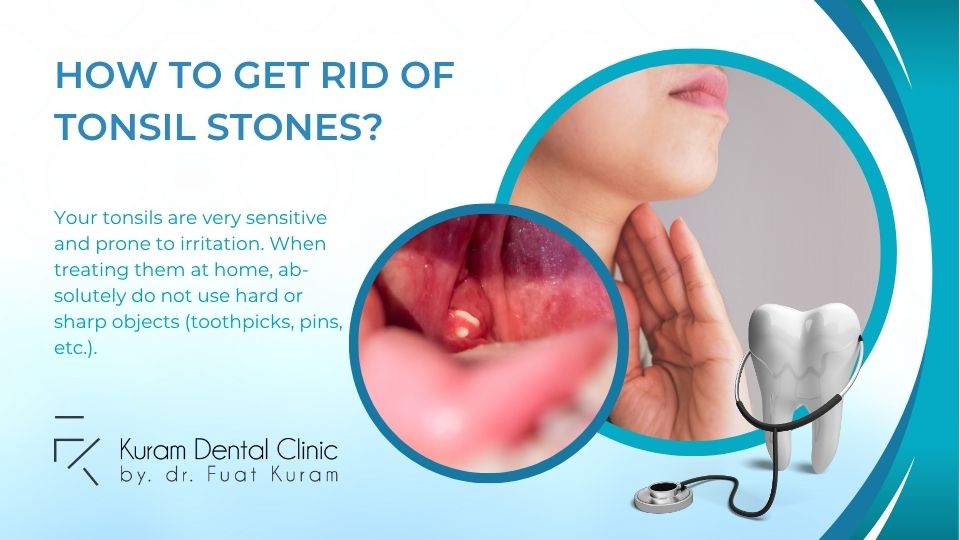
Your tonsils are very sensitive and prone to irritation. When treating them at home, ab-solutely do not use hard or sharp objects (toothpicks, pins, etc.). This can cause bleeding, infection, or push the stones deeper.
Mild gargles (The safest and most effective method)
Salt water gargle:
Add half a teaspoon of salt to a glass of warm water and mix thoroughly. Gargle with this solution 2-3 times a day, especially after meals. Salt water helps loosen stones, re-duce inflammation, and eliminate bad odor.
Mouthwash (Alcohol-free):
Alcohol-free, antiseptic mouthwashes reduce oral bacteria, preventing new tartar formation. Oxygenated mouthwashes may also be effective, but consult your doctor first.
Gentle coughing and swallowing movements
Sometimes stones that are not deep can be dislodged by a strong cough or swallowing movement. Clearing your throat and drinking a little water can trigger this process.
Gentle intervention with a cotton swab or fingertip
- Wash your hands thoroughly.
- Use a soft-tipped, clean cotton swab or your finger.
- Stand in front of a mirror in a well-lit area and look at your tonsil.
- Try to remove the stone by gently pushing it upwards from its socket without pressing too hard on your tonsil. Never scrape it!
- Be sure to gargle with salt water after the procedure.
Water irrigation (rinsing) syringe
- A syringe with a blunt tip, available from pharmacies, is ideal for this procedure.
- Fill the syringe with warm salt water.
- Open your mouth and point the tip of the syringe towards the indentation where the stone is located in the tonsil (without touching it).
- Gently squirt the water to dislodge the stone from its socket. This method is quite safe, as there is no physical contact.
Consuming yoghurt
Probiotic yogurts help regulate the balance of harmful bacteria in the mouth. This can reduce the risk of new stones forming.
Drinking plenty of water
Water keeps your mouth moist and helps clean away food debris and bacteria. Therefo-re, drinking enough water throughout the day is a simple but effective measure.
Medical treatment options for removing tonsil stones
Your doctor may recommend the following treatments depending on your condition:
Antibiotic treatment:
This can be used for a short period to control bacterial infection but does not treat the stones themselves.
Professional (clinic) cleaning and removal procedures
These methods are performed by an ENT specialist to directly remove tonsil stones.
Manual removal with a curette:
- Your doctor will numb your mouth using a local anesthetic (regional anesthetic) spray.
- They will gently press into the tonsil crypts using a special instrument (curette) to remove the stones.
- This procedure is quick and highly effective for superficial stones.
Laser cryptolysis (laser tonsillotomy):
- This involves closing or flattening the pits (crypts) where tonsil stones form.
- Under local anaesthesia, a laser is used to flatten the uneven areas on the surfa-ce of the tonsils. This removes the 'pockets' required for stones to accumulate.
- It is a relatively painless method that heals quickly and solves the problem wit-hout removing the entire tonsils.
Radiofrequency (Coblation) cryptolysis:
- Instead of a laser, low-temperature radio waves are used.
- Rather than burning the tissue, it precisely vaporizes it by creating an ionized plasma.
- It may offer less pain and a faster recovery time compared to the laser method.
Surgical interventions (in severe cases)
If the tonsil stones are very large, recur frequently, and seriously affect the person's quality of life (severe bad breath, difficulty swallowing, constant feeling of a foreign body), the following surgical options may be considered.
Cryptolysis (Scraping procedure):
Unlike laser or radiofrequency methods, the aim here is only to clean the deposits inside the crypts and scrape the surface. This provides temporary relief but may not be a per-manent solution.
Tonsillectomy:
This involves the complete removal of the tonsil tissue where tonsil stones form. As the tonsils are no longer present, stone formation becomes impossible.
Who is it applicable to?
- Those who have recurrent tonsil stones despite all conservative treatments.
- Those with large and difficult-to-remove stones.
- Those with chronic tonsillitis accompanying tonsil stones.
- In cases where it causes bad breath and creates social/psychological distress.
When should you see a doctor?
If any of the following situations apply, you should consult an ENT specialist rather than trying home remedies:
- If you have large or deeply embedded stones that you cannot remove at home.
- If the stones recur frequently and are affecting your quality of life.
- If tonsil stones are accompanied by severe throat pain, difficulty swallowing, or ear pain.
- If your tonsils are swollen, red, or bleeding.
- If your bad breath persists even after removing the stones (there may be another cause).
What precautions should be taken to prevent tonsil stones from forming?
Preventing tonsil stones (tonsilloliths) involves attempting to reverse or minimize the ca-uses of their formation. The fundamental principle is to prevent accumulation and bacte-rial growth in the tonsillar crypts.
Here are some things to keep in mind to prevent tonsil stone formation:
Maintain excellent oral hygiene (the most critical measure)
Oral hygiene aims to eliminate food debris and bacteria before they reach the tonsil crypts.
Regular and proper tooth brushing:
Brush your teeth at least twice a day, preferably after every meal. During brushing, re-member to gently brush your gums and the upper part of the back of your tongue (the area near the tonsils).
Tongue cleaning:
The tongue, especially the back part, is a main reservoir for bacteria and dead cells. Clean your tongue daily with a tongue scraper. This is extremely effective in reducing bad breath and tonsil stone formation.
Flossing:
Food debris left between teeth feeds oral bacteria. Flossing at least once a day will eli-minate this food source.
Mouthwash (non-alcoholic):
- Antibacterial mouthwashes (e.g., those containing chlorhexidine—should be used on doctor's advice) significantly reduce the number of bacteria.
- Oxygenated mouthwashes (containing hydrogen peroxide, used diluted) are ef-fective in killing bacteria and loosening deposits. (Consult your doctor before use).
- Choose alcohol-free options, as alcohol can cause dry mouth and worsen the problem.
- As a natural alternative, you can gargle with salt water.
Adequate fluid intake and prevention of dry mouth
Drink plenty of water:
Drinking enough water throughout the day keeps your mouth moist and helps remove food debris and bacteria before they can stick to the tonsil crypts. Water is a natural cleanser.
Avoid dry mouth:
Breathing through your mouth, dehydration, certain medications, and excessive coffee/alcohol consumption cause dry mouth. Dry mouth is an ideal environment for bacteria to multiply. Chewing sugar-free gum can help by increasing saliva production.
Adjust your eating habits
Reduce sugary and processed foods:
Sugar is the favourite food source for oral bacteria. Reducing these foods helps control the bacterial population.
Adjust your consumption of dairy products
In some people, calcium-rich foods such as milk, cheese, and yoghurt are more likely to cause mucus and buildup. If you think your tonsil stones are triggered by these foods, you can try limiting your intake. However, as these foods are important for nutri-tion, rather than cutting them out completely, take care to rinse your mouth with water after consuming them.
Consume fiber-rich foods:
Chewing hard, fibrous fruits and vegetables such as apples and carrots creates a mechanical cleaning effect, helping the tonsils to clean themselves naturally.
Treatment of underlying health issues
Management of chronic sinusitis and allergies:
Persistent postnasal drip is a significant factor triggering tonsil stone formation. If you have allergies or sinusitis, controlling these with appropriate medication and treatments will reduce mucus production.
Chronic tonsillitis:
If you frequently experience tonsillitis, this condition can damage the structure of the tonsils, facilitating stone formation. You should consult an ENT specialist to assess the condition of your tonsils.
F.A.Q:
Are tonsil stones contagious?
No, they are definitely not contagious. Tonsil stones are formed from bacteria and deb-ris in the individual's own oral flora. There is no possibility of them being transmitted from one person to another or vice versa.
Are tonsil stones dangerous?
They are almost never dangerous. They are mostly harmless and are considered only a nuisance. However, in very rare cases, if they grow to a very large size, they can cause swelling of the tonsils, difficulty swallowing, or difficulty breathing. In such extreme ca-ses, immediate medical attention should be sought.
Do tonsil stones cause pain?
They usually do not cause pain. However, if they become very large or depending on their location, they may cause a feeling of 'something stuck' in the throat, difficulty swal-lowing, mild discomfort, or throat pain due to irritation. The most prominent symptoms are persistent bad breath and a feeling of discomfort.
Do tonsil stones cause persistent bad breath?
Yes, this is the most common symptom. Due to the bacteria and sulphur compounds they contain, they cause a very unpleasant, rotten egg-like odor. Even if you brush your teeth or eat something minty, this odor may not go away because the source is behind your tonsils.
Should I remove tonsil stones myself?
Yes, if done carefully and correctly. However, do not use sharp or hard objects (need-les, toothpicks, etc.). This could cause your tonsils to bleed, become infected, or push the stones deeper. Instead, you can gently intervene with a cotton swab, your fingertip, or a water syringe. Remember to wash your hands and gargle before and after the pro-cedure.
Do tonsil stones recure?
Unfortunately, yes. If your tonsils have a pitted structure (cryptic tonsils), stones may re-form over time as these areas are prone to constant accumulation. For recurrent stones, it is necessary to consult an ENT specialist.
Is there a definitive solution for tonsil stones?
Yes, the definitive solution is surgical removal of the tonsils (tonsillectomy). However, this is generally a last resort. Your doctor may recommend this option if the stones re-cur very frequently, are very large, or seriously impair your quality of life. For milder ca-ses, less invasive methods such as laser-assisted tonsil surface smoothing (cryptolysis) are also available.