
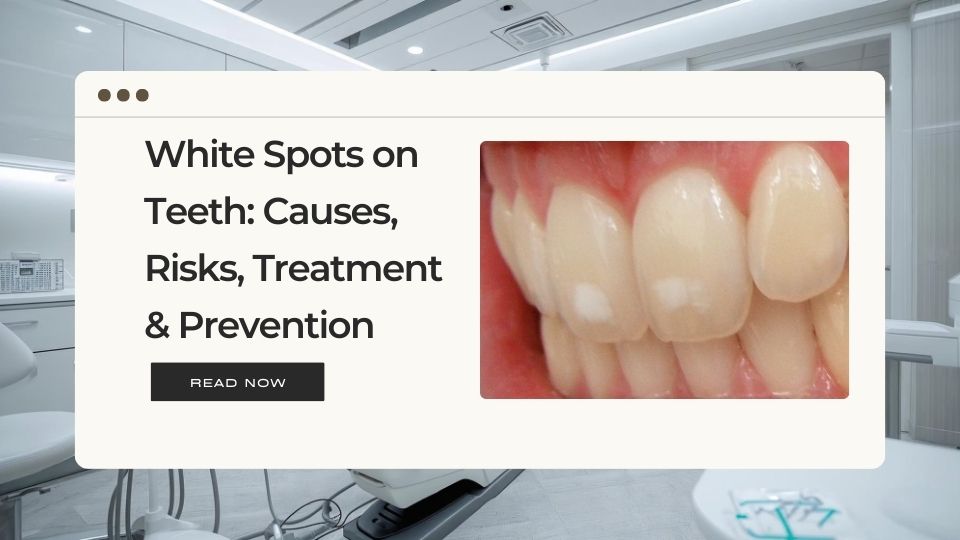
When you look in the mirror and smile, the white spots you notice on your teeth are often perceived as 'just an aesthetic problem'. However, these white areas on the teeth are one of the important signals that the tooth enamel gives us. Sometimes it is an innocent developmental mark, sometimes it is a very early harbinger of tooth decay...
I often hear the following sentence from my patients:
'Sir, my tooth is not decayed, but there are white marks on it.'
In this article, we will discuss the causes of white spots on the teeth, in which cases they pose a risk, how they can be treated and most importantly how they can be prevented in a simple but scientific language.
What do white spots on teeth mean?
White spots on the teeth usually indicate mineral loss in the tooth enamel. Healthy enamel tissue is translucent and reflects the colour of the underlying tooth tissue. However, when enamel is weakened or structurally differentiated, it refracts light differently and these areas acquire a chalky, opaque white appearance.
To summarise:
- White spot = change in enamel texture
- This change is not always rotten
- But in some cases it is the initial stage of caries
Therefore, white spots are early warnings that should not be neglected.
The most common causes of white spots on teeth
1. Dental fluorosis (Excessive fluorine intake)
Dental fluorosis occurs in childhood due to excessive fluorine intake while the teeth are still developing. Fluorine strengthens tooth enamel when taken in the right amount; however, when taken in excess, it can adversely affect the enamel structure.
How does fluorosis occur?
- Swallowing toothpaste as a child
- Drinking water with high fluoride content
- Uncontrolled fluorine supplements
White spots due to fluorosis:
- There are from the moment the tooth erupts
- Usually symmetrical
- Most of the time does not pose a serious health risk
- It is more of an aesthetic problem
In mild cases, small white spots are seen, while in advanced cases yellow-brown colouration may accompany.
2. Enamel hypoplasia (Inadequate development of tooth enamel)
Enamel hypoplasia is a condition in which the enamel develops thinner or irregularly than normal. This is also a childhood problem and affects the developing teeth.
Causes include:
- Febrile illnesses in childhood
- Vitamin and mineral deficiencies
- Premature birth
- Health problems experienced by the expectant mother during pregnancy
- Genetic factors
White spots due to hypoplasia:
- Can be rough, pitted
- Tooth surface can be felt soft
- Significantly increases the risk of caries
For this reason, teeth with hypoplasia are usually not just observed; they often require preventive or restorative treatments.
3. Demineralisation (First stage of caries)
This is the most common cause of white stains in the clinic.
Demineralisation; It occurs when acids produced by plaque bacteria accumulating on the tooth surface pull minerals from the tooth enamel. There is no hole in the tooth yet, but the enamel is weakened.
In this case, white spots:
- It'll come out later
- Most commonly seen at the gum line
- It may darken and turn into caries over time
In particular
- Inadequate tooth brushing
- Not using dental floss
- Frequent consumption of sugary and acidic foods
accelerates this process.
4. White spots after orthodontic treatment (braces)
White stain formation is quite common in patients using braces. The reason for this is not the braces, but the inability to clean the teeth sufficiently while wearing braces.
Plaque that accumulates around the brackets:
- Increases acid production
- Weakens enamel
- Leaves circular white marks when the wire is removed
Most of the time, these spots
- Early stage of caries
- Does not progress if intervened in time
- Aesthetically correctable
5. Dry mouth (Xerostomia)
Saliva is a natural protector for teeth. It neutralises acids, nourishes the enamel and cleans the inside of the mouth.
Dry mouth:
- Acid effect increases
- Plaque accumulates faster
- Increased risk of white spots and caries
Conditions that can cause dry mouth:
- Some medicines
- Systemic diseases
- Mouth breathing at night
- Insufficient water consumption
6. Tooth traumas
Especially in childhood, blows to deciduous teeth may affect the enamel of the underlying permanent tooth. In this case, local white or yellowish spots may appear on the permanent tooth.
How to treat white spots on teeth?
Treatment depends on the cause and the depth of the spot.
Fluoride treatments
- Ideal for early demineralisation
- Re-hardening enamel
- Prevents the transformation into caries
- It may not completely remove the white spot, but it stops its progression
Resin infiltration (ICON)
- Applied without drilling
- Special resin is impregnated into the white stain
- Colour difference disappears to a great extent
- Especially very effective in post-wire spots
Microabrasion
- A very thin layer is removed from the enamel surface
- Effective on superficial spots
- Often combined with bleaching
Tooth whitening
- Can hide blemishes
- Sometimes it can make it more noticeable in the first place
- It is not a stand-alone treatment, it provides aesthetic support
Composite filling or cladding
- Preferred in advanced cases
- The stain is completely hidden
- More invasive, considered as a last option
How to prevent white spots on teeth?
- Brush your teeth with the correct technique at least 2 times a day
- Always use dental floss
- Prefer fluoride toothpaste
- Limit sugary and acidic foods
- Drink plenty of water
- Do not neglect interdental brushes if you use braces
- Control the amount of toothpaste in children
- Visit the dentist every 6 months
Frequently asked questions
Is the white spot on my tooth caries?
Not all white spots are caries, but some may be the beginning of caries.
Do white spots go away on their own?
Usually no. They may progress or remain fixed.
Does teeth whitening remove white spots?
Not completely, no. It can only stabilise the appearance.
Are white spots dangerous?
It depends on the cause. If it is due to demineralisation, it should be followed up.
Conclusion
White spots on the teeth are early warning signs given to us by the teeth. Sometimes it may be an innocent developmental trace, sometimes it may be the silent beginning of caries. Therefore, they should not be seen as 'insignificant' and should be evaluated by a dentist.
Don't forget:
Good oral hygiene is the strongest defence against white spots.