
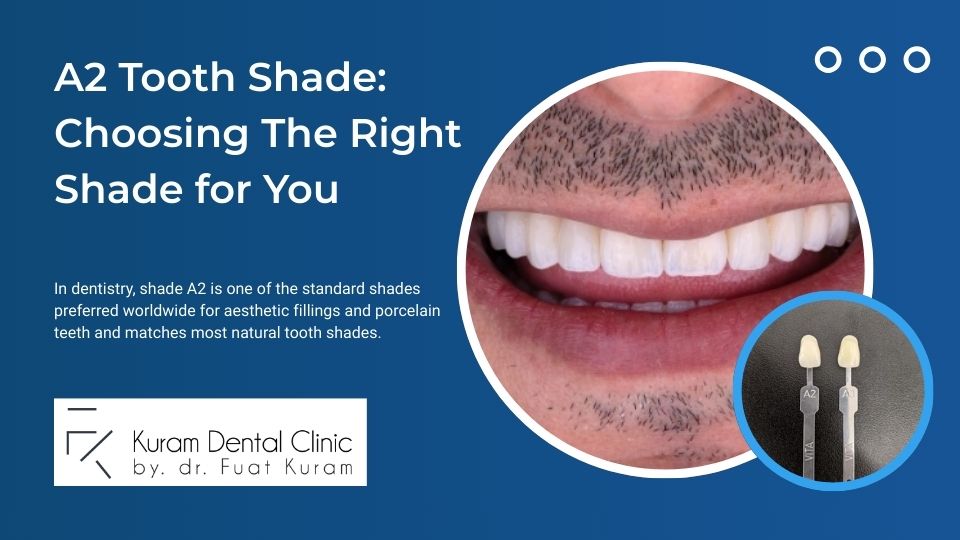
In dentistry, shade A2 is the globally preferred standard shade for aesthetic fillings and porcelain teeth, matching the majority of natural tooth shades.
You will find out why this shade, used by dentists to determine the colour of your teeth, is so important and how perfect matching is achieved in the following detailed sections
What is the tooth color scale?
The tooth color scale is a standardized tool used in dentistry to accurately determine the color, brightness, and translucency of a patient's natural teeth and to communicate this information to the dental technician or laboratory. These scales are very important for ensuring that aesthetic restorations (such as fillings, crowns, and veneers) match natural teeth and do not look artificial.
Fundamental dimensions of the colour scale
Hue:
This is the name of the color (e.g., brownish, yellowish, greyish, or reddish). It is the primary color family of the tooth. Group A represents the red-brown tones found in most natural teeth.
Value:
The most important dimension indicating how light or dark a color is. Value is the most critical factor in the tooth's appearance; our eyes may miss color differences but will immediately notice a discrepancy in brightness. Brightness matching is more critical than hue matching for the success of a restoration.
Chroma (Saturation):
This is the intensity or strength of the color tone. For example, the A2 shade is more intense (darker) than A1 and lighter than A3.
Commonly used systems
The most widely accepted systems worldwide have been developed by VITA:
VITA classical A1-D4:
This international standard system consists of 16 different shades. The shades are divided into four main groups:
- Group A: Reddish-brownish (A1, A2, A3, A3.5, A4)
- Group B: Reddish-yellowish
- Group C: Greyish shades
- Group D: Reddish-grey
VITA System 3D-Master:
This is a more modern and systematic approach. It presents 26 different shades covering natural tooth colors, grouped according to brightness (value) levels.
VITA Bleachedguide:
This is a special scale used for planning tooth whitening (bleaching) procedures and monitoring their results.
How does your dentist determine the shade?
Choosing the right shade is not just a matter of a glance; specific steps are followed to minimize the margin of error:
Light and environment:
Shade selection is performed under light that is as close to daylight as possible. The patient's lipstick must be removed, and any brightly colored clothing must be covered with a grey apron, as these colors can reflect into the eyes and be misleading.
Speed factor:
The human eye tires after looking at a color for more than 5-7 seconds and begins to confuse colors. That is why your dentist relies on their first impression and makes a quick decision.
Moisture:
Teeth appear much whiter when dry than when they are in the chair. Therefore, shade determination is performed at the beginning of the appointment, while the teeth are still moist.
Digital eyes:
The human eye has an accuracy rate of only around 27% when matching tooth color. For the most sensitive cases, digital devices such as the VITA Easyshade V are therefore used. These devices:
- Provide objective results by measuring the wavelength of light.
- Are not affected by ambient light, thus eliminating the margin of error.
A2 What is the color?
A2 is a natural-looking, medium-shade tooth color found on the VITA classical A1-D4 scale, the globally recognized standard color system used in dentistry. It is commonly referred to as 'natural white' and is a color with warm tones that does not exaggerate brightness.
Characteristics of the A2 shade
Natural appearance: The A2 shade is close to the natural tooth color of most people. It does not give an overly white ('Hollywood white') appearance.
Warm tones: Its reddish-brown undertones allow it to blend with facial warmth.
Versatility: It is compatible with many skin tones and age groups.
Aesthetic balance: Noticeably white yet remains within natural limits.
Who can opt for the A2 tooth shade?
- Those seeking a natural look: Ideal for those who want a smile where their teeth are white but do not appear artificial.
- Middle-aged and older individuals: Excessively white teeth may appear less age-appropriate. A2 creates a natural youthful effect in mature individuals.
- Those with warm skin tones: Particularly compatible with skin tones that have a golden or olive undertone.
- Those getting laminates, veneers, or fillings: A2 is often preferred when it is important to match neighboring natural teeth.
Why is A2 used in 80% of cases?
Dentists typically try the A2 shade first in aesthetic filling (composite) applications. There are several reasons for this:
Chameleon effect:
Modern filling materials (e.g., Neo Spectra ST or Estelite Alpha) have the ability to reflect the color of the surrounding natural tooth structure and blend in with it. The A2 shade is one of the colors that provides the most natural transition.
Universal compatibility:
Research shows that the majority of natural teeth are A2 shades or very close to A2.
Low margin of error:
A2 is neither too white (like A1/B1) nor too yellow (like A3.5); this balance ensures patient satisfaction in 80% of cases.
Which is the best choice for you?
Although A2 is very popular, not all teeth are the same. For example, canine teeth (eyeteeth) generally have a more intense color (higher chroma) than front teeth. Your dentist can take these differences into account and design a more natural smile, for example, by using A1 on the front teeth and A2 or A3 on the sides.
If your dentist recommends the 'A2' shade, this is generally a safe choice that will provide the best match with your natural tooth structure and avoid looking 'artificial.'
Tips for choosing tooth colour
- If restoration is required, it is essential that the new teeth match your existing natural teeth.
- Cool skin tones (pink, blue undertones) generally match better with B group colors, while warm skin tones match better with the A group.
- Younger individuals may prefer lighter shades, while slightly darker shades appear more natural in older age.
- Ultimately, this is a personal preference. Your dentist can make suggestions, but the decision is based on your expectations and lifestyle.
Teeth colour selection should be done in natural daylight. Artificial light can alter color perception.
How to Maintain the A2 Color?
To maintain the A2 color, the following points should be noted:
- Regular oral hygiene (brushing twice a day, flossing)
- Rinsing your mouth after consuming staining foods and beverages (coffee, tea, red wine)
- Dental check-ups and professional cleaning twice a year
- Avoiding cigarettes and tobacco products
Will the color of A2 fillings change after teeth whitening?
The color of A2 fillings (or any other shade of composite filling) will not change after teeth whitening (bleaching). The main reason for this is that whitening agents only affect natural tooth structure. To ensure aesthetic harmony, once the whitening process is complete and the color of your teeth has stabilized (usually after 1-2 weeks), existing fillings may need to be replaced to match your new tooth color. Your dentist will provide you with the most appropriate plan in this regard.
Common reasons why A2 fillings do not change color after teeth whitening (bleaching) are as follows:
Different materials, different reactions:
Natural tooth: Has a porous structure. The active ingredients in the whitening gel (usually hydrogen peroxide or carbamide peroxide) penetrate the tooth enamel, breaking down organic staining molecules and whitening the tooth.
Filling material (composite/porcelain): These materials are non-porous and inert (non-reactive). Whitening chemicals cannot penetrate these materials and cannot break down the color pigments. The filling remains the same color as when it was applied (A2).
Fundamental difference:
Whitening is a chemical process (oxidation of color molecules).
Changing the color of the filling is a physical process (it needs to be replaced).
Colour mismatch
After whitening, your natural teeth become lighter (e.g., B1 shade), but your old A2-colored fillings remain the same. This causes the fillings to appear darker and more noticeable.